
Transport in Marrakech: how to get around
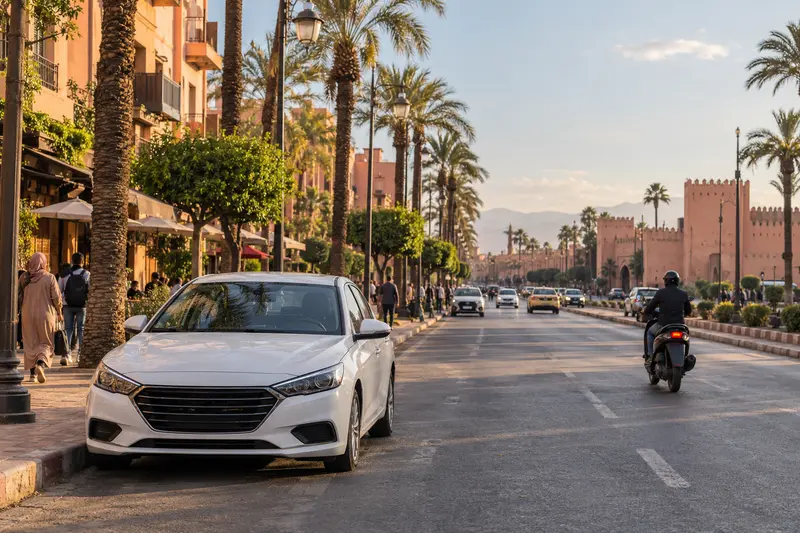
Marrakech is easy to get around once you know which option suits which trip. Inside the medina you walk. Across the city, the ochre petit taxis are quick and cheap as long as the meter is running. Buses cost a few dirhams and go to the airport. For other cities there are trains and coaches, and for everything in between there are shared grand taxis and private drivers. Here is what each one costs in 2026, how it works, and when it is the wrong choice.
The short version
| Option | Typical cost (2026) | Best for |
|---|---|---|
| Walking | Free | Anywhere inside the medina |
| Petit taxi | About 15-35 MAD across the city by day, on the meter | Short hops for up to three people |
| City bus | About 4-6 MAD; airport line 19 is 30 MAD | Travelling light on a budget |
| Grand taxi | A fixed price per seat | Nearby towns and valleys, shared |
| Train | Casablanca in about 2 h 40 | Casablanca, Rabat, Fes, Tangier |
| Coach | Essaouira for about 80-120 MAD | Essaouira, Agadir and other routes with no railway |
| Private driver | A fixed price agreed in advance | Night arrivals, luggage, families, day trips |
The figures come from operators and recent travellers, and they change often. Check before you rely on one.
Walking: the medina is made for feet
Most of the old city is a maze of lanes too narrow for cars. Taxis stop at the gates and at the edges of the big squares, and many riads can only be reached on foot from the nearest street a car can use. Motorbikes and hand carts share the lanes, so keep to the side. If you are staying in the medina, ask your riad where the nearest point a car can reach is before you arrive; many will send someone to meet you there.
Petit taxis: quick, cheap and metered
Petit taxis are the small ochre cars you will see everywhere. They carry up to three passengers and only work inside the city limits.
- Ask for the meter. Drivers are required to use it. If it is not running, ask for it before you set off, or agree the fare first.
- Expect about 15-35 MAD by day for most trips across town (2026 reports).
- A 50% night rate applies in the evening. Sources put the start at around 20:00 in winter and 21:00 in summer.
- Sharing is normal. A driver may stop for another passenger heading the same way.
- At the airport, taxis are sold at an official kiosk at a fixed fare for each zone rather than on the meter: about 100-160 MAD since January 2024.
City buses: a few dirhams, and a new operator
Since December 2025, Marrakech’s city and suburban buses have been run by Supratours, the coach company of the national rail operator ONCF. It took over from ALSA, which had run the network for 26 years, and redesigned the routes with a larger fleet. You will also see the service called Marrakech Hafilaty.
- Tickets cost about 4-6 MAD in 2026, depending on the line. Board at the front, say where you are going and pay the driver in cash; small change helps.
- Buses run from about 06:00 until 21:00-22:00.
- Line 19 is the one most visitors use. It links Menara airport with Jemaa el-Fna for 30 MAD, and the ticket covers the return journey within 15 days. Buses run about every 20-30 minutes during the day, less often in the evening.
- Line numbers in older guides may be out of date, because the network was redesigned. Check at the stop or ask where you are staying.
Grand taxis: shared rides out of town
Grand taxis are larger cars and vans that run fixed routes to nearby towns and between cities. They have no meter: you pay a set price for a seat, and the car leaves when it is full.
- Older grand taxis are Mercedes saloons carrying six passengers; they are gradually being replaced by seven-seat vans.
- The main stand is at Bab Doukkala, next to the bus station. Someone will usually ask where you are going and take you to the right car.
- For more room, pay for two seats, or hire the whole car and agree the price before you leave.
- As a guide, a seat to Essaouira costs about 80-120 MAD and the whole car about 450-900 MAD (2026).
Trains: the best way to Casablanca and the north
Marrakech station is on Avenue Hassan II in Gueliz, the new town, and it is the southern end of Morocco’s railway.
- Casablanca: about 2 h 40, with trains every one to two hours.
- Fes: about 6 h 30 to 7 h 30, usually with a change at Casablanca Voyageurs.
- Tangier: a little over 5 hours by day, changing onto the Al Boraq high-speed train, or a direct overnight train with couchettes.
- No trains south. There is no railway to Essaouira or Agadir.
Book on the ONCF website, oncf-voyages.ma, or at the station.
Coaches: CTM and Supratours
For routes with no railway, the two national coach companies are the comfortable choice, with reserved seats and a luggage hold.
- CTM leaves from its own station on Rue Abou Bakr Seddiq in Gueliz.
- Supratours leaves from its terminal next to the train station, and sells combined train-and-coach tickets.
- Essaouira: about 3 hours, for about 80-120 MAD (2026).
- Agadir: about 2 h 45 to 4 hours, depending on the service (2026).
Book on ctm.ma or supratours.ma, especially at weekends and in high season.
Apps: Uber is back, with conditions
Uber returned to Morocco in November 2025, starting in Casablanca and Marrakech. Only licensed tourist transport operators can register vehicles, so there are fewer cars than you may be used to, with UberX for up to four people and UberXL for larger groups. Apps such as inDrive also work in Marrakech, but their drivers generally do not hold a passenger transport licence, which is exactly why Uber came back only with licensed operators.
Horse-drawn carriages
The calèches waiting near Jemaa el-Fna and outside the big hotels take up to five people. They are a sightseeing ride rather than a way of getting somewhere: posted rates are around 150-180 MAD an hour (2026), and the route and the time are negotiable, so agree both before you climb in.
When a private driver is worth it
Most of the time a taxi or the train is the right answer, and we say so on every route page. A car booked in advance makes sense when:
- you land late at night, or with children and luggage;
- you want to see the Ourika valley, Imlil or the Agafay desert without joining a group;
- you have several stops in one day;
- you are going to Essaouira or Agadir and would rather not change at a bus station.
You get a fixed price before you travel and pay the driver in the vehicle, in cash or by card. See private driver hire, airport transfers, transfers to other cities and day trips from Marrakech.
Frequently asked questions
- Is there Uber in Marrakech?
- Yes, again. Uber returned to Morocco in November 2025, starting in Casablanca and Marrakech, but only licensed tourist transport operators can put cars on the platform, so there are fewer of them than you may be used to. Other apps also work, but their drivers generally do not hold a passenger transport licence (2026).
- How much does a taxi cost in Marrakech?
- A petit taxi across the city usually costs about 15-35 MAD by day on the meter, with a 50% night rate in the evening. From the airport, fares are fixed by zone at the official kiosk: about 100-160 MAD since January 2024. Treat these as 2026 guides rather than guarantees.
- Can I take a bus from Marrakech airport?
- Yes. City bus line 19 runs between Menara airport and Jemaa el-Fna. A ticket costs 30 MAD in 2026 and covers the return journey within 15 days; buses run about every 20-30 minutes during the day, less often in the evening.
- Is there a train from Marrakech to Essaouira or Agadir?
- No. The railway ends at Marrakech. Essaouira and Agadir are reached by coach, grand taxi or car. Supratours, the coach company of the national rail operator ONCF, sells combined train-and-coach tickets.
When you would rather not deal with it
A fixed price agreed before you travel, a licensed driver who meets you, and nothing to negotiate at the kerb. Paid in the vehicle, in cash or by card.