
Ourika Valley: the closest mountains to Marrakech
- Destination
- Ourika Valley
- Duration
- 8 hours
- Departs
- 09:00
- From
- Price on request
Photographs
Get a price now
A real number on this page, not a quote by email tomorrow.
- Your trip
- Contact
We price this one by hand
This journey is not in our published rate card yet. Send what you have entered and you will get a real number back, usually within the hour.
Ask on WhatsAppOurika Valley day trip itinerary
A typical 8-hour day, departing Marrakech at 09:00. Times are indicative and the driver will flex them to suit you.
Pickup in Marrakech
From your riad or hotel, or the nearest medina gate if cars cannot reach the door.
Into the valley
The road climbs south out of the Haouz plain and the temperature starts dropping almost immediately. The change from city to mountains is abrupt.
A Berber village and an argan cooperative
Optional. The road passes Berber villages and argan cooperatives, and your driver will stop at one if you wish.
Setti Fatma
The village at the head of the valley and the start of the walk to the waterfalls. The first cascade is a scramble of twenty minutes or so; the higher ones take considerably longer.
Lunch by the river
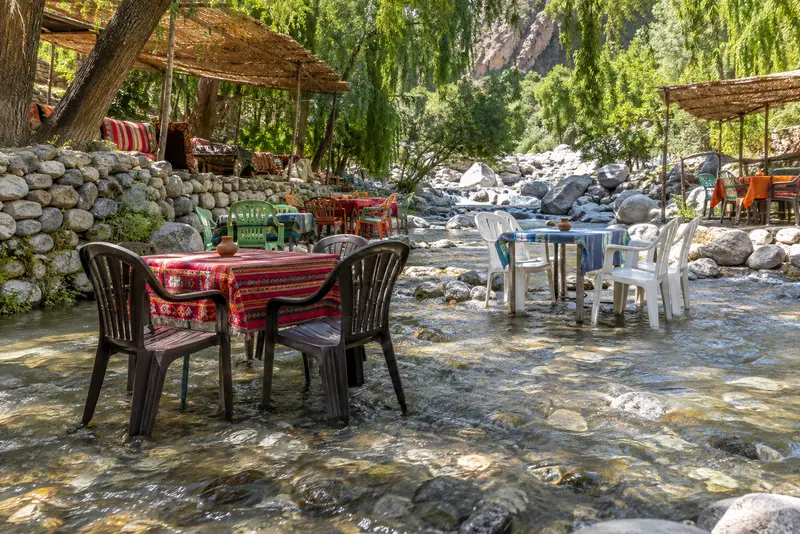
Restaurants here put tables literally in the river, which is the point. A tagine is about 60–130 MAD (2026). Some riverside cafés charge just for the seat, so agree prices before you sit down.
Start back
Or later. The valley is at its best in the afternoon and there is no need to rush.
Back in Marrakech
In time for the evening in the medina.
What is and is not included
Included
- Private air-conditioned vehicle and licensed driver
- Hotel or riad pickup and drop-off in Marrakech
- Fuel and all driver costs
- Waiting time throughout the day
Not included
- Lunch and drinks — a tagine is about 60–130 MAD at the river restaurants (2026)
- Local guide for the higher waterfalls — not needed for the first one; about 100–200 MAD (2026), agree the price first
- Argan cooperative purchases
- Tips
What it costs
Price on request
Why the Ourika is the trip we suggest most
The Ourika Valley’s advantage over every other day trip from Marrakech is simple: it is close. The mouth of the valley is about 30 km from the city and Setti Fatma at its head is around 60 km, which means you are among mountains and running water within roughly an hour of leaving your riad.
That matters more than it sounds. Most excursions from Marrakech cost you four or five hours of driving for a few hours of destination. Ourika inverts that ratio. You can leave at nine, have a long lunch with your feet near a river, walk to a waterfall, and be back in the medina in time for the evening — and nobody in the car is worn out.
It is also the trip that changes the temperature most reliably. Marrakech in summer is brutal. Twenty-five minutes up the valley it is noticeably cooler, and by Setti Fatma it can feel like a different season.
What the valley is actually like
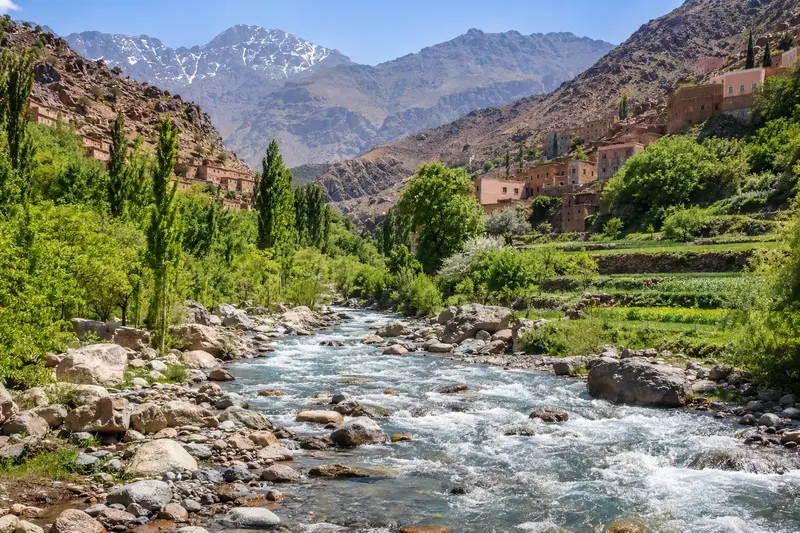
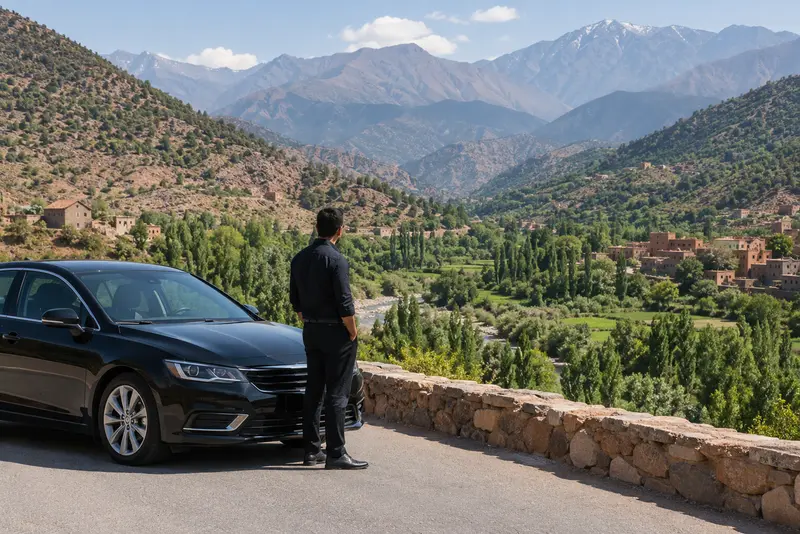
You leave the city heading south and cross the flat, dry Haouz plain with the Atlas as a wall in front of you. Then the road enters the valley and everything changes at once: the walls close in, the river appears alongside, and the slopes above are terraced and green with walnut and fruit trees.
Berber villages sit on the terraces along the way, built from the same red earth as the hillside. Some have been substantially reshaped by tourism, and you should expect that. Others are simply villages people live in.
The road ends at Setti Fatma, a strung-out village on the river which is the starting point for the walk to the waterfalls. There are seven cascades in theory. In practice most visitors see the first, which is a twenty-minute scramble over boulders and across stepping stones, and turn round there. Getting to the higher ones is a real climb and takes the best part of a morning.
The single most Ourika thing, and the reason a lot of people come back, is lunch. The restaurants at Setti Fatma put their tables in the river itself — plastic chairs on platforms in the shallows, water running underneath you, tagines arriving over the top. It should not work and it is wonderful.
Being honest about its limits
The Ourika is not the most spectacular valley in the High Atlas. If you have walked in the Alps or the Rockies, or if you go on to Imlil later in your trip, you will find it pleasant rather than astonishing.
It is also busy. This is where Marrakech itself comes to escape the heat, so summer weekends bring large local family groups and the atmosphere at Setti Fatma becomes something closer to a crowded park than a mountain retreat. That is genuinely enjoyable if you are in the mood for it and disappointing if you expected solitude. Weekdays are quieter.
And the waterfall walk is not the graded path some descriptions imply. It is a scramble on wet rock. Perfectly manageable in reasonable shoes, unpleasant and slightly risky in flip-flops.
Who it suits
Families with young children, more than any other trip we run. Short drive, water, food, no obligation to walk anywhere.
Anyone with one spare half-day rather than a full one.
People who want mountains but not a mountain day — you can see the High Atlas properly from the valley without committing to altitude or a hike.
It suits less well anyone who wants a serious walk. That is Imlil, where the paths are longer, the air is thinner and the mountains are the point rather than the backdrop.
Practical things worth knowing
Wear shoes you can scramble in if you intend to reach even the first waterfall.
You do not need a guide for the first waterfall at Setti Fatma: the way is waymarked. For the higher falls a guide helps. Expect about 100–200 MAD (2026), and agree the price before you set off.
Go on a weekday if you can, particularly in July and August.
Take the river seriously. The Ourika is a mountain river valley and it floods fast. A flash flood in August 1995 was deadly. On 6 August 2025 another serious flood came down the valley; warning sirens told people to leave the riverbed, and nobody died. Floods have struck with summer afternoon thunderstorms. If it is raining, or storms threaten upstream, stay off the riverbed and the river terraces, and if the siren sounds, leave immediately.
At the argan cooperatives, buy if you want to and do not feel obliged. Our drivers take no commission, which is precisely why they will tell you which stops are worth your time.
Our price is for the vehicle rather than per person, so the more of you there are the less each pays — the opposite of a per-seat coach tour.
Compare the fleet on our vehicles page, browse everything on the day trips hub, or see the price list. If you would rather have desert than greenery, the Agafay is a similar distance in the opposite direction.
What eight hours actually means
A 09:00 departure and roughly eight hours out puts you back in Marrakech in the late afternoon, not at lunchtime. Leave a margin if you have anything booked that evening.
Who this suits, and when to go
Easy — suitable for most people, no walking required beyond short strolls
Best months: Mar, Apr, May, Sep, Oct. Spring is the best time — the river is full and the valley is green. The river can flood fast, as it did in August 1995 and on 6 August 2025, and summer afternoon thunderstorms are when floods have struck. If storms threaten, stay off the riverbed, and leave at once if the warning siren sounds.
Reviews
No reviews for this trip yet. We only show reviews that real customers have left us, and we never write them ourselves.
Combine this with
- The Agafay Desert: a stone desert an hour from Marrakech5 hours · Agafay Desert
- Imlil and the High Atlas: a real mountain day from Marrakech9 hours · Imlil
- Hire a private driver by the dayBuild your own itinerary instead of taking ours
Questions people ask about this trip
- How far is the Ourika Valley from Marrakech?
- About 30 km to the mouth of the valley and roughly 60 km to Setti Fatma at its head, which is under an hour and a half of driving. It is the closest mountain scenery to the city by a wide margin, which is exactly why it works as a half or three-quarter day.
- Is the Ourika Valley worth it?
- Yes, if you want green and cool without a long drive. It is not the most dramatic valley in the Atlas and anyone who has spent time in serious mountains will find it modest. What it is, is genuinely close, genuinely cooler than the city, and a completely different landscape within an hour.
- How hard is the walk to the Setti Fatma waterfalls?
- Getting to the first cascade takes about twenty minutes and involves scrambling over rocks and crossing the river on stepping stones. It is not a graded path. The higher falls are a longer and rougher climb. Wear shoes with grip; plenty of people attempt it in sandals and regret it.
- Can we do Ourika with young children?
- Yes, and it is the trip we most often suggest for families. The drive is short, there is water to play in, the restaurants are relaxed about children, and you can turn round whenever you like. Just be realistic about the waterfall scramble with very small ones.
- What is the difference between Ourika and Imlil?
- Ourika is a green river valley you drive up, with villages, restaurants and a modest waterfall walk. Imlil is the trailhead for Toubkal, higher, barer and steeper, and it is where you go if you actually want to walk in mountains. Ourika is the gentler day out; Imlil is the one that needs boots.
- Is the valley busy?
- At weekends, very. Ourika is where Marrakech goes on a hot day, so Saturday and Sunday afternoons in summer are crowded with local families. That can be good fun or it can be the opposite of what you came for. Go on a weekday if you want it quiet.
- Are the argan cooperatives worth stopping at?
- The genuine women's cooperatives, yes — you see the oil pressed, the process is explained and the money stays local. The roadside shops selling the same bottles at higher prices are not. Our drivers take you to a cooperative and do not take commission on what you buy.
Book this trip
A licensed driver, a private vehicle and a day that runs to your pace.